
Quick answer: You can find someone’s location on Google Maps in 2026 by asking them to enable Location Sharing in the Google Maps app, by using Google Find Hub (the renamed Find My Device) for a Google account you own, or — with proper consent — through a parental monitoring app such as mSpy, EyeZy, or Hoverwatch. Tracking anyone without their knowledge and consent is illegal in most jurisdictions, so this guide focuses on lawful, transparent methods.
Google Maps now powers location and navigation for more than 2 billion monthly users, according to Google’s own reporting on its global products. With that scale, real-time location sharing has become a normal part of family safety, dating, ride-sharing, and travel planning. But how it works — and what’s legal — has changed significantly since 2024.
- Before You Start: The Consent Rule You Cannot Skip
- Method 1: Google Maps Location Sharing (The Official Way)
- How to enable Location Sharing on Android or iPhone
- What changed in 2024–2026
- When Location Sharing is the wrong tool
- Method 2: Google Find Hub (Formerly Find My Device)
- Method 3: Apple’s Find My App (For iPhone Users)
- Method 4: Parental Monitoring Apps (For Minors Only)
- Method 5: WhatsApp Live Location
- Method 6: Bluetooth Trackers (AirTag, Pixel Tracker Tag, Tile)
- Methods That Don’t Actually Work (Or Are Illegal)
- How to Protect Your Own Location Data
- Privacy-First Alternatives to Google Maps
- Frequently Asked Questions
- Can I find someone’s location on Google Maps without them knowing in 2026?
- Is Google location data private?
- How accurate is Google Maps location sharing?
- Does Google notify someone when I track their location?
- Can I track a turned-off phone?
- Is using a spy app legal?
- The Bottom Line
This 2026 guide walks you through every legitimate way to find someone’s location on Google Maps and on the wider Google ecosystem, the consent rules you must follow, and how to protect your own location data from being tracked without permission.
Before You Start: The Consent Rule You Cannot Skip
Tracking another adult’s location without their informed consent is a criminal offense in most U.S. states, the UK, the EU, Pakistan, India, and Australia. In the U.S., it can fall under federal Electronic Communications Privacy Act (ECPA) violations, plus state-level stalking laws.
There are only a few legitimate scenarios for tracking someone:
- Parents tracking a minor child they have legal custody of
- Employers tracking company-owned devices with documented employee consent
- Mutual location sharing between adults who have both opted in
- Locating your own lost device signed in to your own Google account
If your scenario does not fit one of those categories, stop here. Our guide on the legality of using spy apps explains the legal boundaries in more detail.
Method 1: Google Maps Location Sharing (The Official Way)
Location Sharing is the feature Google built specifically for this purpose. It works on Android and iPhone, requires the person to opt in, and is the only method that will not get you in legal trouble.
How to enable Location Sharing on Android or iPhone
- Open Google Maps on the device whose location will be shared.
- Tap the profile icon in the top-right corner.
- Select Location sharing → Share location.
- Choose how long to share: For 1 hour, a custom duration, or Until you turn this off.
- Pick the contact, Google account, or app to share with (Gmail, Messages, WhatsApp, etc.).
- Tap Share.
The recipient can now open Google Maps, tap their profile → Location sharing, and see the live position on the map. They will also see the last time the device updated and the battery level.
What changed in 2024–2026
Google moved live location data storage from cloud servers to on-device only for added privacy. That means location history now lives encrypted on the phone, not in your Google account. If you switch phones, your historical Timeline does not automatically follow you unless you back it up.
When Location Sharing is the wrong tool
- The person refuses or has not opted in
- You need historical movement data, not just a live pin
- You’re trying to find a lost or stolen device (use Find Hub instead)
Method 2: Google Find Hub (Formerly Find My Device)
In May 2025, Google rebranded Find My Device as Find Hub and expanded it to include Bluetooth tag tracking, offline finding through the crowd-sourced device network, and integration with luggage and pet trackers.
Find Hub only works for devices linked to a Google account you have legitimate access to — typically your own devices, or a child’s device on a Google Family Link account.
How to use Find Hub in 2026
- Go to google.com/android/find or open the Find Hub app.
- Sign in with the Google account associated with the device.
- The dashboard shows all signed-in devices with their last known location.
- Select a device to view its position, play a sound, lock it, or erase it.
- For offline devices, Find Hub uses the encrypted Bluetooth network to triangulate a recent location through nearby Android phones.
This is the right tool when a phone is lost, stolen, or when a child’s device has gone offline. If you’re worried about vehicle theft instead, our guide on how to find a stolen car without a tracker covers a different set of methods.
Method 3: Apple’s Find My App (For iPhone Users)
If the person you want to locate uses an iPhone, the Apple equivalent of Find Hub is the Find My app — Apple renamed and merged “Find My iPhone” and “Find My Friends” back in iOS 13 and has refined it every year since.
Two consensual ways to locate an iPhone
Option A — Family Sharing. If you’re part of an Apple Family Sharing group (up to six people), members can opt to share their location automatically with everyone in the group.
- On the target iPhone, open Settings → [Your Name] → Family Sharing → Location Sharing.
- Toggle Share My Location on.
- On your iPhone, open Find My → People tab — the family member’s location appears on the map.
Option B — Direct sharing with a contact.
- Open Find My → People → Share My Location.
- Enter the contact and choose Share for One Hour, Share Until End of Day, or Share Indefinitely.
You no longer need to share an Apple ID for this — that practice was a security risk and Apple has fully deprecated it. If you’ve ever shared an Apple ID with someone, our piece on how to stay safe from spying explains how to detach your accounts safely.
Method 4: Parental Monitoring Apps (For Minors Only)
When you’re a parent monitoring a child’s phone, dedicated monitoring software gives you more than Google Maps offers: location history, geofencing alerts, screen time controls, and app activity. These are not “spy apps” in the covert sense — modern app stores require the monitored device to display an indicator, and U.S. law (COPPA) and the EU’s GDPR both treat minors’ data with extra protections.
Below are the parental monitoring tools we currently consider reliable in 2026. If you need a broader comparison, see our full roundup of the best spy apps.
mSpy
mSpy remains the most established parental monitoring product, with active GPS tracking, geofencing, route history, and integration with messaging and social apps. It works on Android and iOS (iOS via iCloud sync for non-jailbroken devices). Our complete mSpy review covers setup, features, and cost in detail.
EyeZy
EyeZy markets itself as a parental control tool with AI-assisted alerting — it can flag suspicious contacts or risky language in messages. Its Pinpoint map view shows real-time GPS plus Wi-Fi triangulated location, useful when GPS signal is poor (indoors, dense urban areas).
Hoverwatch
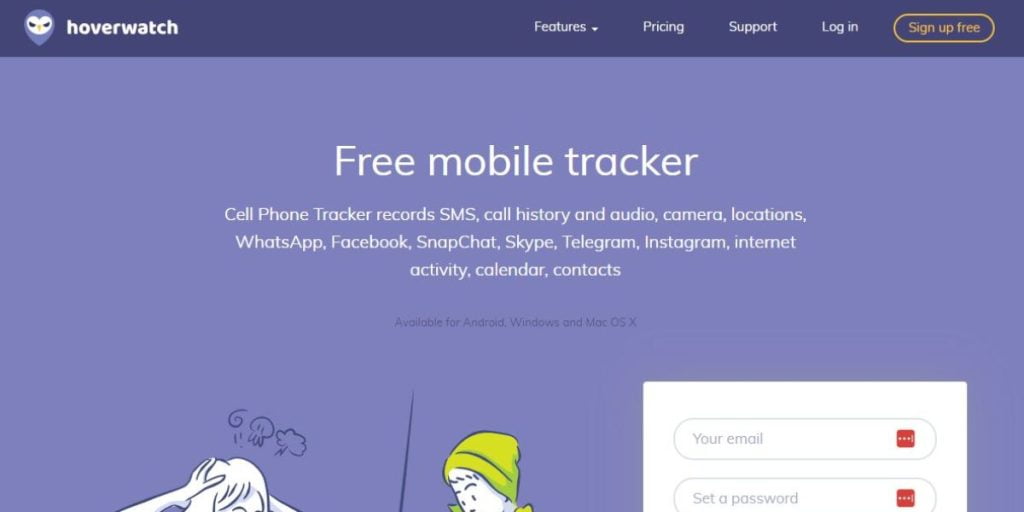
Hoverwatch focuses on stealth on Android only and supports geofence alerts. It does not work on iOS without significant compromise. Note that “stealth” features that hide the app from the user can violate consent laws in some jurisdictions — use only on devices where you have legal authority and ideally have disclosed the monitoring.
TheOneSpy
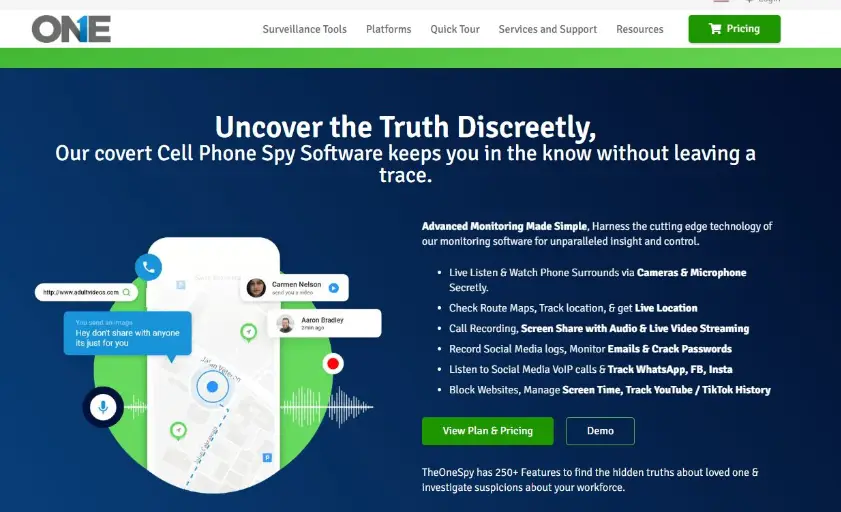
Built more for enterprise device management than family use, TheOneSpy offers geofencing, route reports, and remote camera access on managed devices.
Important note about Cocospy: Earlier versions of this article recommended Cocospy. The brand has been effectively defunct since the 2024 ClevGuard data breach exposed customer records, and we no longer recommend it. The same applies to Spyzie — see our coverage of the Spyzie data leak.
How to choose between them
| Use case | Best fit |
|---|---|
| Parent of a child on Android | mSpy, Hoverwatch, EyeZy |
| Parent of a child on iPhone | mSpy (iCloud), EyeZy |
| iPhone without target access | See our guide on the best iPhone spy app without access to target phone |
| Need just a GPS pin, no monitoring | A dedicated GPS tracker |
| Just want to share location with family | Google Maps Location Sharing (free) |
Method 5: WhatsApp Live Location
WhatsApp’s Live Location is end-to-end encrypted and shares a real-time map for 15 minutes, 1 hour, or 8 hours.
- Open the chat with the person you want to share with.
- Tap the + (iOS) or paperclip (Android) icon → Location → Share live location.
- Choose a duration and tap Send.
WhatsApp Live Location does not produce a Google Maps overlay, but the receiver can tap the map to open it in Google Maps for navigation. This method is fully consent-based — both parties see exactly what is being shared.
Method 6: Bluetooth Trackers (AirTag, Pixel Tracker Tag, Tile)
If you want to know where a bag, car, or item is — not a person — a Bluetooth tracker is the right tool. As of 2025, Apple and Google launched cross-platform unwanted-tracker alerts, so an AirTag traveling with an Android user (or a Google-network tag with an iPhone user) will trigger a notification. This was a deliberate response to stalking concerns documented by the Electronic Frontier Foundation.
That cross-platform alert system is why these trackers are now suitable only for items and pets, not for tracking people.
Methods That Don’t Actually Work (Or Are Illegal)
The internet is full of articles promising location tracking by phone number alone or through “free secret apps.” Almost all of them are scams, malware, or affiliate traps. Here’s the reality:
- Tracking by phone number alone is restricted to law enforcement with a warrant and telecom carriers. Public “phone number lookup” tools can give you a carrier and rough region, but not a live pin. For legitimate lookup purposes, see our best reverse phone number lookup tools.
- “Free GPS tracker” Telegram bots and SMS links are phishing payloads designed to steal credentials or install malware. Our explainer on how attackers execute malware through scripts walks through how these attacks work.
- Sharing the same Apple ID as a covert tracking trick — Apple now flags this aggressively and the practice creates massive security holes.
- GPS spoofing apps to fake your own location are a separate use case. If that’s what you’re after, our Pokemon GO spoofing guide covers the legitimate methods on iOS and Android.
How to Protect Your Own Location Data
Once you understand how location sharing works, it becomes obvious how exposed your own data can be. Here’s how to harden your privacy in 2026.
On Android
- Settings → Location → App permissions — review every app with location access. Set most to Allow only while using the app.
- Settings → Location → Location services → Google Location Accuracy — turn off if you don’t need Wi-Fi/Bluetooth-assisted precision.
- myactivity.google.com — pause Timeline and Web & App Activity if you don’t want Google to log your routes.
On iPhone
- Settings → Privacy & Security → Location Services — review every app.
- Settings → Privacy & Security → Tracking — disable Allow Apps to Request to Track.
- Settings → Privacy & Security → Location Services → System Services → Significant Locations — clear history and toggle off.
Use a VPN
A reputable VPN doesn’t hide your GPS coordinates from apps you’ve granted location permission to, but it does mask your IP-based location from websites, ad networks, and trackers. That’s a meaningful layer of defense — and our roundup of the best privacy tools and the best VPN services covers what we recommend in 2026.
For broader anonymity practices beyond location, see 5 methods to stay anonymous online.
Privacy-First Alternatives to Google Maps
If you don’t want Google holding your location history at all, consider:
- Apple Maps — significantly improved since 2024 and doesn’t tie searches to your account in the same way.
- Organic Maps — open-source, no tracking, offline-first.
- OsmAnd — also based on OpenStreetMap, more feature-rich.
- HERE WeGo — independent of the Google/Apple duopoly.
These won’t help you locate other people, but they will dramatically reduce how much location data you generate.
Frequently Asked Questions
Can I find someone’s location on Google Maps without them knowing in 2026?
No, not legitimately. Google Maps Location Sharing always requires the other person to enable it on their device, and they can see who they’re sharing with. Any method that promises covert tracking of another adult without consent is either illegal, a scam, or both. The only consensual exceptions are children’s devices managed through Family Link and your own devices through Google Find Hub.
Is Google location data private?
Google stores location data tied to your account if you have Timeline and Web & App Activity turned on. Since 2024, Timeline data is stored on-device instead of in the cloud, which is more private — but third-party apps with location permission can still log and share your coordinates. Audit your permissions regularly at myactivity.google.com.
How accurate is Google Maps location sharing?
Accuracy depends on the device and environment. Outdoors with clear GPS, location is typically accurate to within 5 meters. Indoors or in dense urban areas, the device falls back on Wi-Fi and cell tower triangulation, which can be off by 20–100 meters or more.
Does Google notify someone when I track their location?
Yes, when location sharing is active, the person sharing sees an ongoing notification or status indicator that they are sharing location, and they can revoke access at any time. Find Hub queries for a device may also surface in account activity logs if the account owner reviews them.
Can I track a turned-off phone?
Not with GPS. However, Apple’s Find My network and Google’s Find Hub can sometimes show the last known location before the phone went offline, and Bluetooth-based finding may surface the phone if it passes close to other phones on the same network. This is useful for lost phones but not for live tracking.
Is using a spy app legal?
It is legal to use monitoring software on a device you own or on the device of a minor child under your custody, provided you comply with local laws. It is generally not legal to install monitoring software on another adult’s device without their knowledge and consent, even a spouse’s. Our deep-dive into the legality of spy apps covers jurisdictional differences.
The Bottom Line
Finding someone’s location on Google Maps in 2026 is straightforward when the other person has agreed to share — Location Sharing, Find Hub, WhatsApp Live Location, and Apple’s Find My all give you reliable, real-time visibility for free. For parents monitoring a child’s safety, dedicated tools like mSpy and EyeZy add geofencing, history, and alerts that Google Maps alone doesn’t offer.
What hasn’t changed since 2024 is the consent rule: tracking another adult covertly is illegal, ethically indefensible, and almost always associated with abusive behavior. The same tools that let you see where your family is can be turned against you. Audit your own location permissions monthly, use a trusted VPN, and treat your location data like the sensitive personal information it is.