
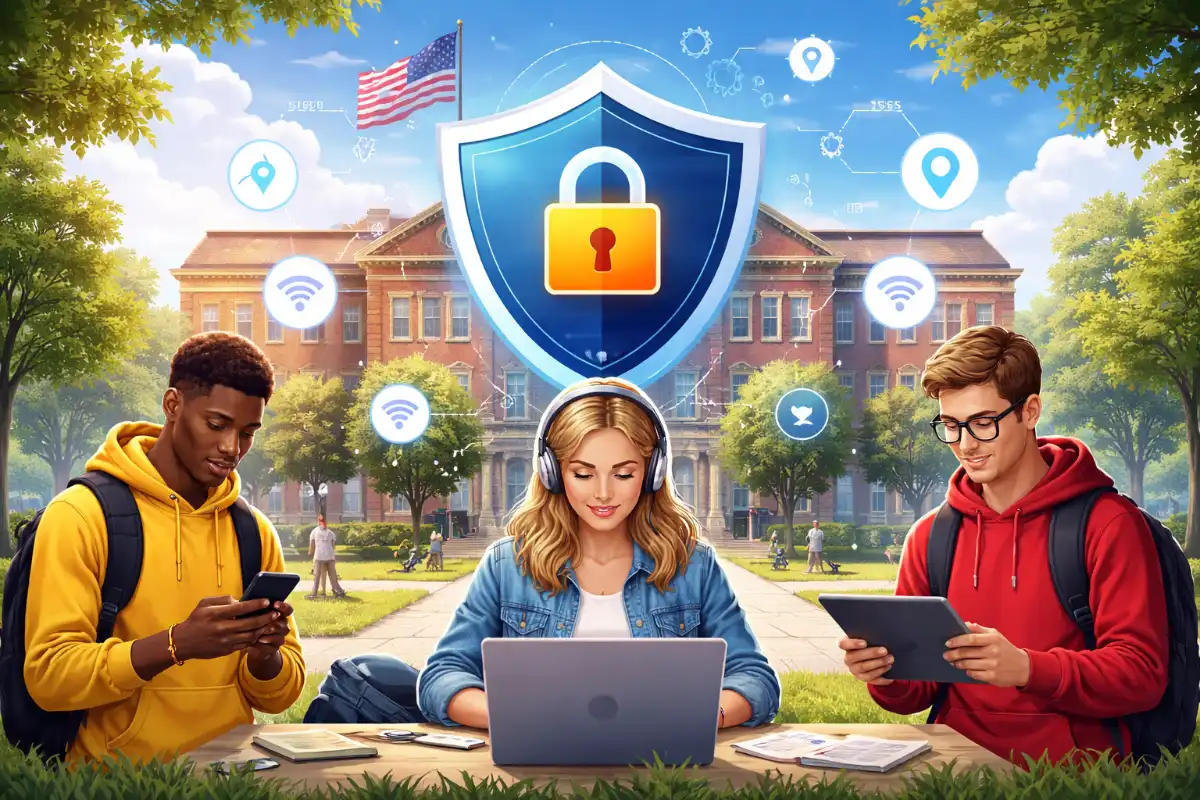
College life in the United States is deeply connected to the internet. From online classes and research portals to streaming, gaming, and social media, students rely on constant connectivity. That same reliance also creates risks—especially on campus Wi-Fi and public networks.
- What Is a VPN and How Does It Work for Students?
- Do College Students Really Need a VPN?
- Is Using a VPN Legal for Students in the USA?
- Key Features Students Should Look for in a VPN
- Affordable Pricing or Student Discounts
- Campus Wi-Fi Compatibility
- No-Logs Policy
- Streaming Access
- Device Limits
- Best VPN for Students USA (2026)
- NordVPN – Best Overall for Students
- Surfshark – Best Budget VPN for Students
- ExpressVPN – Best for Speed and Reliability
- CyberGhost – Best for Streaming-Focused Students
- Private Internet Access (PIA) – Best for Customization
- Free VPNs vs Paid VPNs for Students
- When a Free VPN Might Be Acceptable
- How to Use a VPN on Campus Wi-Fi
- Common Student VPN Mistakes to Avoid
- VPN Use Cases for Students
- FAQs
- Do college students need a VPN?
- Is it legal to use a VPN at university in the USA?
- Can schools detect VPN usage?
- Are free VPNs safe for students?
- Which VPN works best on campus Wi-Fi?
- Can a VPN unblock Netflix on a college internet?
- Does a VPN slow down internet speed?
- Conclusion
A VPN, or Virtual Private Network, helps students protect their privacy, secure their data, and access content without unnecessary restrictions. But not every VPN is suitable for student life. Budget limits, dorm network restrictions, and streaming needs all change the equation.
This guide focuses specifically on finding the best VPN for students USA, balancing affordability, safety, speed, and ease of use—without overpaying for features you don’t need.
What Is a VPN and How Does It Work for Students?
A VPN creates an encrypted tunnel between your device and the internet. Instead of connecting directly through your ISP or campus network, your data passes through a secure VPN server.
For students, this means:
- Your IP address is masked
- Your browsing activity is encrypted
- Public and campus Wi-Fi becomes significantly safer
- Geo-restricted content becomes accessible
Most student-friendly VPNs work through apps on Windows, macOS, iOS, and Android, and can protect multiple devices at once.
Do College Students Really Need a VPN?

Short answer: Yes—especially in the US.
Students often connect through:
- Dorm Wi-Fi
- Campus libraries
- Coffee shops
- Airports
- Shared apartments
These networks are common targets for data interception and tracking. A VPN reduces exposure to:
- Account hijacking
- Data snooping
- ISP throttling
- Location-based restrictions
VPNs are also widely used by international students in the USA who want secure access to services from home or protection when traveling.
Is Using a VPN Legal for Students in the USA?
Yes. VPNs are legal in the United States, including for students.
However, universities may have acceptable-use policies for campus networks. Using a VPN for privacy and security is generally allowed, while using one to violate school rules or academic integrity policies is not recommended.
Responsible use matters.
Key Features Students Should Look for in a VPN

Not all VPNs are built with student needs in mind. These features make the biggest difference:
Affordable Pricing or Student Discounts
Students don’t need $15/month enterprise plans. Look for:
- Long-term plans under $5/month
- Student or education discounts
- Money-back guarantees
Campus Wi-Fi Compatibility
Some dorm networks block certain traffic types. A good student VPN should offer:
- Multiple protocols
- Automatic reconnection
- Obfuscation or stealth modes (when available)
No-Logs Policy
A true no-logs VPN doesn’t store:
- Browsing history
- Connection timestamps
- IP address activity
This matters for privacy, especially on shared networks.
Streaming Access
Students often want VPNs for Netflix, Hulu, Disney+, or YouTube. Not all VPNs can bypass streaming restrictions consistently.
Device Limits
College students usually own:
- A laptop
- A smartphone
- Sometimes a tablet or shared device
Look for VPNs allowing at least 5–7 simultaneous connections.
Best VPN for Students USA (2026)
Below are the most student-friendly VPN options based on affordability, performance, and campus compatibility.
NordVPN – Best Overall for Students
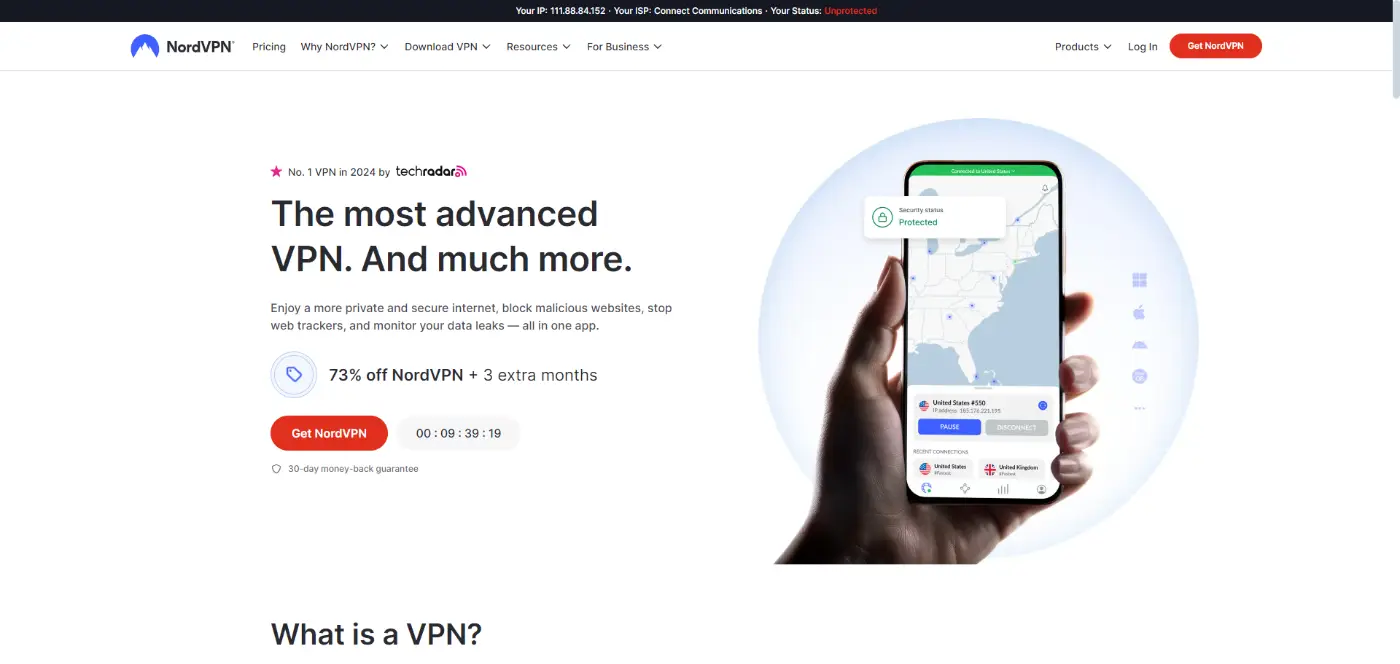
NordVPN combines strong security with fast speeds and reliable US servers.
Why students choose it:
- AES-256 encryption and strict no-logs policy
- Excellent performance on campus Wi-Fi
- Works well with Netflix, Hulu, and Disney+
- Apps are beginner-friendly
Considerations:
- Monthly plans are expensive, but long-term plans are student-friendly
NordVPN is ideal for students who want premium performance without constant troubleshooting.
Surfshark – Best Budget VPN for Students
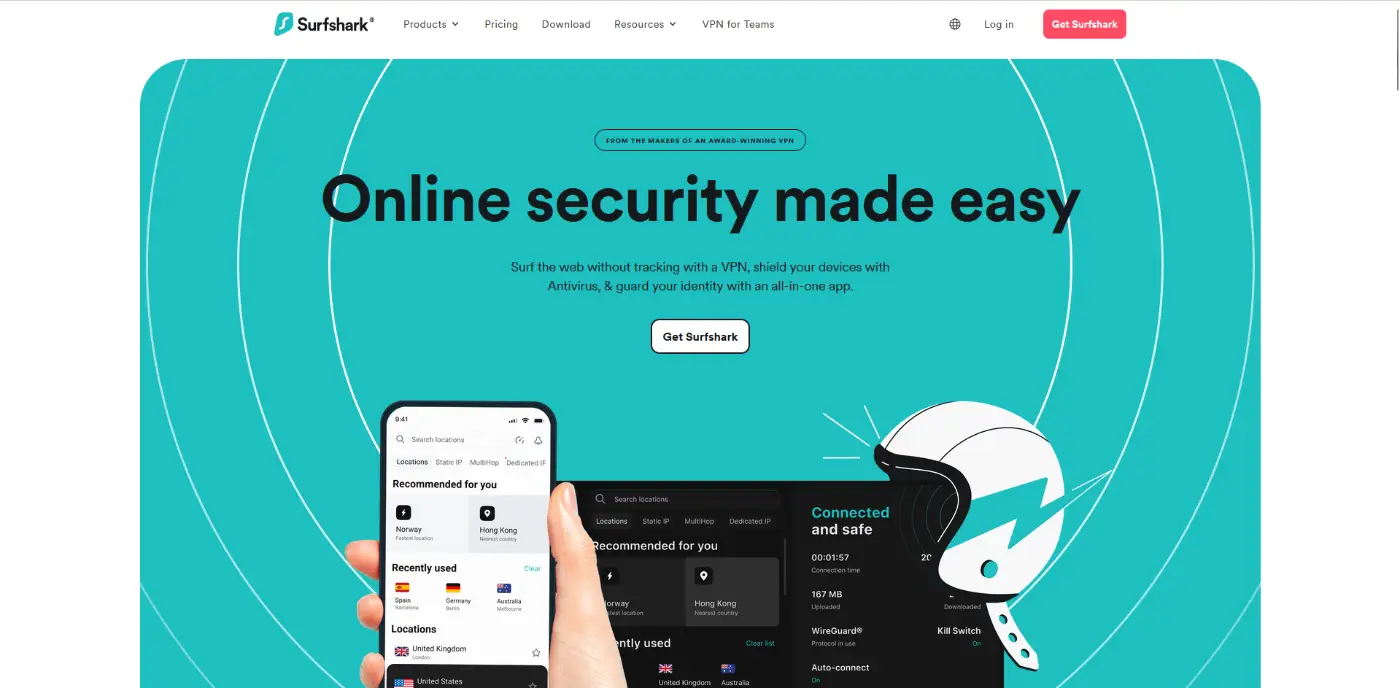
Surfshark is popular among students because of its unlimited device connections.
Why students choose it:
- Very affordable long-term pricing
- Unlimited devices per account
- Works on dorm and public Wi-Fi
- Clean, simple apps
Considerations:
- Slightly fewer advanced controls than premium providers
Surfshark is perfect for shared apartments, roommates, or students with multiple devices.
ExpressVPN – Best for Speed and Reliability
ExpressVPN is one of the fastest VPNs available, though it comes at a higher cost.
Why students choose it:
- Consistent speeds for streaming and gaming
- Reliable access on restricted networks
- Strong privacy standards
- Works well for international students
Considerations:
- Higher price point
- No specific student discount
Best for students who prioritize performance over budget.
CyberGhost – Best for Streaming-Focused Students
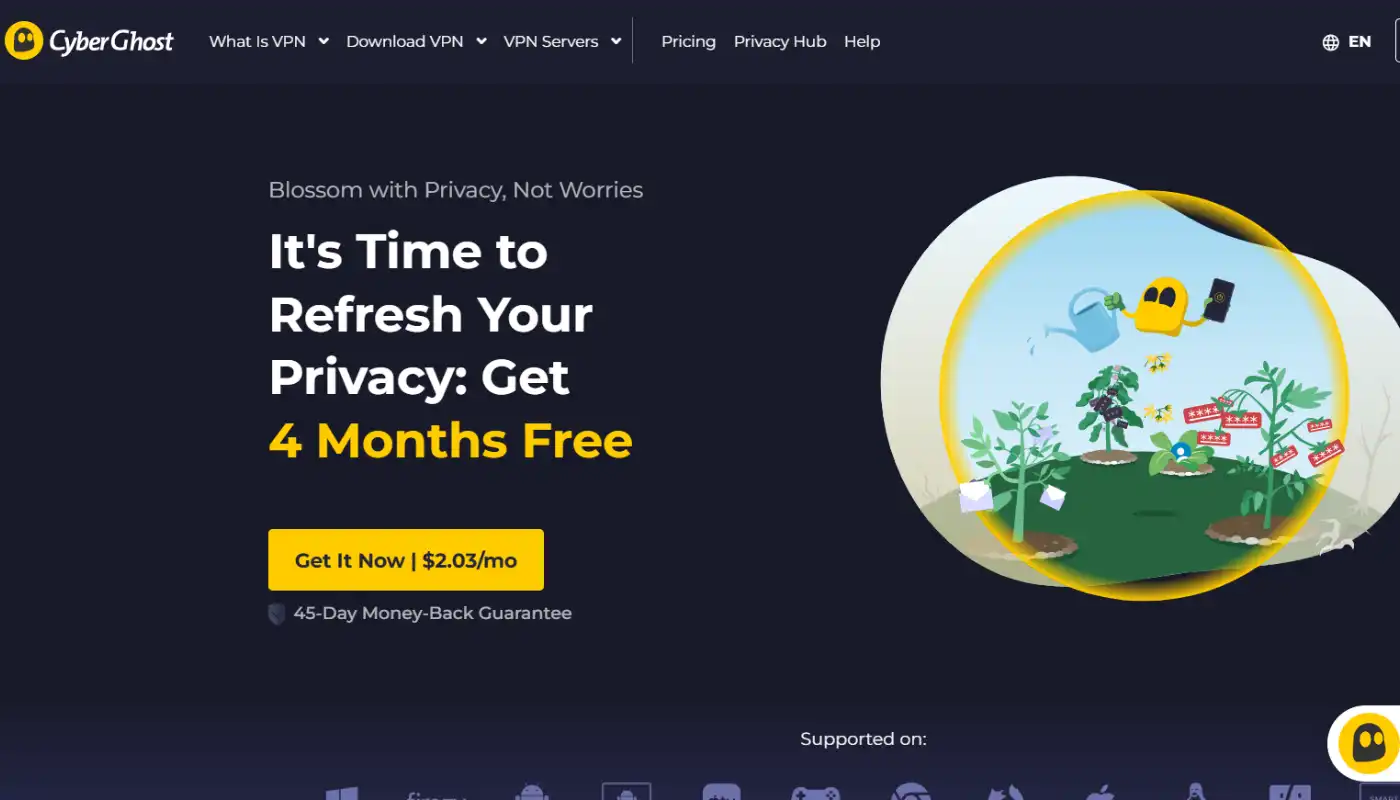
CyberGhost offers optimized servers for streaming and general browsing.
Why students choose it:
- Dedicated streaming servers
- Simple interface
- Strong US server presence
- Affordable long-term plans
Considerations:
- Less customization for advanced users
A good fit for students mainly using VPNs for entertainment and general privacy.
Private Internet Access (PIA) – Best for Customization
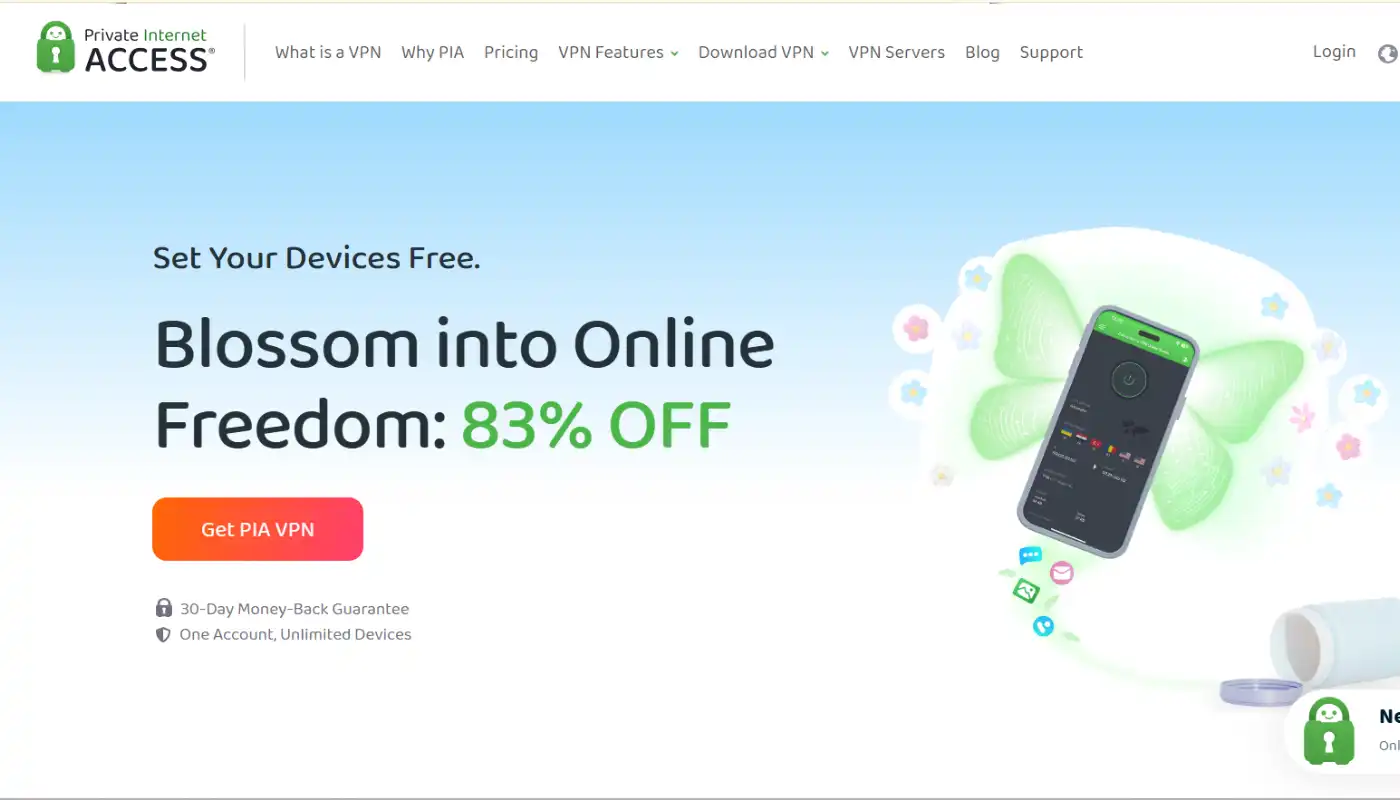
PIA is known for transparency and advanced configuration options.
Why students choose it:
- Open-source apps
- Highly configurable settings
- Competitive pricing
- Strong privacy reputation
Considerations:
- Interface may feel technical for beginners
Best for tech-savvy students who want control.
Free VPNs vs Paid VPNs for Students
For students on a tight budget, free VPNs can look appealing at first glance. However, the differences between free and paid VPNs are significant—especially when it comes to privacy, performance, and campus usability.
| Feature | Free VPNs | Paid VPNs |
|---|
| Cost | $0 | Low monthly cost (often under $5 with long-term plans) |
| Data Limits | Very limited (500MB–2GB/month) | Unlimited or very high data |
| Speed | Slow and inconsistent | Fast and stable for daily use |
| Campus Wi-Fi Compatibility | Often blocked or unstable | Designed to work on dorm & university networks |
| Privacy & Logging | Logging policies unclear or risky | Strict no-logs policies |
| Encryption Level | Basic or inconsistent | Strong encryption (AES-256 standard) |
| Streaming Access | Rarely works with Netflix/Hulu | Reliable access to US streaming platforms |
| US Server Availability | Very limited or none | Multiple US locations |
| Device Support | 1 device or limited platforms | Multiple devices (5–unlimited) |
| Ads & Tracking | Common | None |
| Customer Support | Minimal or none | 24/7 support (chat/email) |
| Best For | Short, non-sensitive tasks | Daily use, studying, streaming, privacy |
Free VPNs: What Students Should Know
Most free VPNs operate with heavy limitations or hidden trade-offs. While a few reputable providers offer limited free tiers, many free VPNs survive by monetizing user data.
Common drawbacks of free VPNs include:
- Strict data caps (often 500MB–2GB per month)
- Slow speeds, especially during peak hours
- Limited server locations, usually outside the US
- Inability to unblock streaming platforms
- No guarantee of a true no-logs policy
- Ads, trackers, or data-sharing practices
On campus Wi-Fi, free VPNs often struggle. Dorm networks can block VPN traffic, and free services typically lack alternative protocols or obfuscation features needed to stay connected. This leads to frequent disconnections and failed connections during classes or study sessions.
For students handling sensitive tasks—email, banking, research accounts, or international logins—free VPNs can introduce real privacy risks rather than solving them.
Paid VPNs: Why They’re Usually Worth It for Students
Paid VPNs are designed to provide reliable security and performance, even on restricted or high-traffic networks like universities.
Key advantages of paid VPNs include:
- Strong encryption (AES-256 or equivalent)
- Verified no-logs policies
- Consistent speeds for streaming and browsing
- Multiple US server locations
- Compatibility with Netflix, Hulu, and Disney+
- Reliable apps for laptops and mobile devices
- Customer support when campus networks block access
Many premium VPNs also offer long-term plans under $3–$5 per month, which is comparable to the cost of a coffee. Some providers include student discounts or extended money-back guarantees, making them accessible even on a student budget.
Best Paid VPNs Under $5 for Students
| VPN Provider | Starting Price (Monthly) | Best For Students Who Need | Key Student Benefits |
|---|---|---|---|
| Surfshark | ~$2–3 | Multiple devices & roommates | Unlimited devices, fast speeds, strong privacy |
| NordVPN | ~$3–4 | Security + streaming | High-speed servers, works on campus Wi-Fi, no logs |
| Private Internet Access (PIA) | ~$2–3 | Budget-focused students | Huge server network, customizable security |
| Atlas VPN | ~$2 | Simple & beginner-friendly | Easy apps, solid speeds, student-friendly pricing |
| CyberGhost | ~$2–4 | Streaming & browsing | Optimized servers for Netflix & YouTube |
If you’re studying abroad, using public campus Wi-Fi, or streaming US content, a paid VPN under $5 is far safer and more reliable than any free VPN — especially long term.
When a Free VPN Might Be Acceptable
A free VPN may be acceptable only if:
- It comes from a trusted paid provider
- It’s used occasionally, not daily
- You’re not accessing sensitive accounts
- You understand the data and speed limits
Even then, free VPNs are best viewed as temporary solutions—not long-term privacy tools.
How to Use a VPN on Campus Wi-Fi
- Install the VPN app on your device
- Log in before connecting to campus Wi-Fi
- Choose a nearby US server
- Enable auto-connect and kill switch
- Use responsibly within university guidelines
Some networks may require you to connect first, then activate the VPN.
Common Student VPN Mistakes to Avoid
- Choosing free VPNs with unclear policies
- Ignoring device limits
- Using VPNs during exams or on restricted academic platforms
- Forgetting to enable the kill switch
- Selecting distant servers with slow speeds
VPN Use Cases for Students
- Securing the dorm and public Wi-Fi
- Accessing US streaming services
- Preventing bandwidth throttling
- Protecting personal data
- Studying abroad with consistent access
- Avoiding intrusive tracking
FAQs
Do college students need a VPN?
Yes. VPNs protect students on campus Wi-Fi, improve privacy, and help access content safely.
Is it legal to use a VPN at university in the USA?
Yes. VPNs are legal, but students should follow the university network policies.
Can schools detect VPN usage?
They may detect encrypted traffic, but reputable VPNs don’t reveal browsing activity.
Are free VPNs safe for students?
Most free VPNs come with privacy risks and limited performance.
Which VPN works best on campus Wi-Fi?
NordVPN and Surfshark consistently perform well on dorm networks.
Can a VPN unblock Netflix on a college internet?
Yes, but only some VPNs reliably work with US streaming platforms.
Does a VPN slow down internet speed?
A small reduction is normal, but good VPNs maintain fast performance.
Conclusion
Choosing the best VPN for students USA isn’t about buying the most expensive option—it’s about finding the right balance of privacy, performance, and price. Campus Wi-Fi, tight budgets, and everyday streaming needs make student requirements unique.
A reliable VPN helps students stay secure, avoid unnecessary restrictions, and protect their digital lives throughout college and beyond. With the right provider and responsible use, a VPN becomes a practical everyday tool—not just an extra app.
Whether you’re living in a dorm, studying abroad, or connecting from a coffee shop near campus, the right VPN gives you control over your online experience.